Do you want to find out more about mysterious Russia without moving too far from your computer? Here you will find reviews of the websites and programs for learning Russian, interesting facts about the language and culture, shortcuts to useful information and things to discover when you travel to Russia.
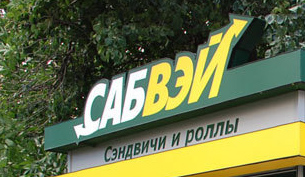
This quiz should be fun even if you haven't studied cyrillic letters yet. Let's imagine that you are already in Russia. Most of the Russian cities start to look similar to other big metropolis in other counties thanks to globalization and a big quantity of chain stores familiar all over the world. The only difference is that in Russia their names are written in cyrillic alphabet. ;) so, this is how it feels to see them in a Russian city and you can use this chance to check how well you read Russian letters. Guess the franchise you are looking at and then you can find the correct answers at the end of the post.
1. Let's start with an easy one to warm up.
2. This one you can also guess without being able to read well.
3. This is one of the "classic" ones ;)
4. It starts to get tricky.
5. Still not too difficult.
6. A bit more difficult as you see some really weird letters...
7.
8.
9. You might be surprised how often Russians use "English" words instead of Russian ones.
10. This is harder as it has some cursive letters too.
11. Again, some cursive to keep you awake.
12. This is a very tricky one as it has a completely different name in Russian.
And at the end a very unexpected example just to give you an idea that it is not always with cyrillic letters... and you will see a lot of funny and surprising things in Russia! :)
(the quote under the sign says "the taste of Russia")
Correct answers:
1.Ikea 2.Subway 3.Macdonalds 4.Sbarro 5.Starbucks 6.TGI Friday's 7.Burger King 8.Pizza Hut 9.Chicken Pizza 10.Kebab House 11.Wendy's 12.KFS "Rosticks"
If you have some interest in Russia or Russian language, but you are
afraid of the difficult grammar and impossible tongue twisting words,
have a look at the following reasons why it is worth to learn Russian and keep up your motivation to
overcome all difficulties.
The 5th most spoken language in the world
Russian is the 5th most spoken language in the world by total
number of speakers and the 8th by number of native speakers. It is one of
the six official languages of the United Nations.
Russian is also one of the official languages in Belarus, Kazakhstan and
Kyrgyzstan. It is unofficial but widely spoken in Latvia, Estonia,
Moldova, Ukraine. Many people from the countries of the former USSR speak Russian.
It is a myth that Russian is one of the most difficult languages
If you google "most difficult languages" you will not find
Russian even in the top of 25! It is true that endings of the words and
cases can be very confusing. On the other hand, there are only three tenses. If
you study hard, you can start speaking the basic every-day Russian already in a
couple of months.
New
business opportunities
Trading in or with Russia can create new possibilities for your work or your business. There is no way you can build connections with Russian
businessmen, authorities and companies without speaking the
language.
Traveling
in Russia with comfort
If you are planning to discover Russia as a traveller, it will be very
useful to speak some Russian as you need to read street names in Cyrillic and all train announcements are made only in Russian.
Russia is the world's largest country, but if you speak Russian you will be able to talk to and to understand people from Europe to the Pacific Ocean. There can be some differences in
pronunciation and vocabulary, but in most of the cases you will understand
everything.
Understand other
languages
Russian belongs to the East
Slavic branch of the Slavic languages. Knowing Russian will help
you understand Belarussian and Ukrainian
on a basic level as well as some Polish, Czech, Slovak, Bulgarian, Serbian, Croatian, Bosnian or
Slovenian.
You don't need to learn that many
words
The Russian language has about 500,000 words, but in order to speak in every-day life you will use only 2,000-2,500. And even better news is that the 100
most frequently used words make up 20% of all written and oral language.
The 2nd most used
language on the Internet
If your work or business is very internet-dependent, you should really consider having your website translated into
Russian and starting to learn Russian, in order to connect with Russian speaking
customers. It is also not a secret that you can find a lot of free “things” on
Russian websites (films, music, lessons, books, software etc. that are not
necessarily illegal to download)
The
key to building relationships with a Russian
It is all over the Internet that Russian ladies are looking for
boyfriends and husbands! And it is true. If you already have a relationship or you would like to have one, start learning Russian today. Even if the girl speaks a foreign
language, in 99,9% of the cases her family doesn’t. As Russian families are
overprotective, it will be hard to build relationships with a lady without
being approved by the family and friends. Without any doubt, speaking some Russian will help you gain their trust and respect.
Read famous books in their original language
Knowing Russian will allow you enjoy all the richness and original language of famous books by Tolstoy, Dostoevsky,
Pushkin and other famous Russian writers.
It
is an “international language of space”
If you want to be an astronaut, you will have to learn Russian, as it is
an obligation and a requirement of NASA, ESA and all Space Agencies.
From my experience these are the phrases that foreigners visiting Russia encounter the most. The only exception is if you are traveling to Russia with a tour agency in a group of foreigners and don't get to stay in the company of Russians. Even if so, it will never hurt to learn a bit of Russian and show it off, if you get a chance to do so.
Here you can find writing in Russian, how it sounds in English and the translation. In the transcription, vowels with a sign ' are the ones where you put the accent and pronounce it longer.
Да[dah]- Yes
Нет[net]- No
Привет [preeve't]- Hello (informal)
Здравствуйте [zdra'stvuiteh]- Hello (formal) Comment: in general the formal way of addressing people is used if you don't know the person well and if the person is older than you (in work environments people tend to always use the formal).
Спасибо[spasee'bah]- Thank you
Пожалуйста[pazha'lustah]- Please / You are welcome / Here you are Comment: in Russian we have the same word for all the above meanings! :-)
Меня зовут ...[meenya'h zavu't]- My name is ... Я из[yah eez] - I am from ... Италии [eeta'lyee] - Italy, США [s-sh-ah] - USA, Великобритании [veleekobreeta'nyee] - Great Britain, Франции [fra'ntsyee] - France, Германии [gheerma'nyee] - Germany, Испании [eespa'nyee] - Spain
Мне нравится [mneh nra'veetsah]- I like it Мне очень нравится[mneh o'chen nra'veetsah] - I like it a lot
Очень красиво [o'cheen krasee'vah]- Very beautiful Comment: you can also use only "красиво" [krasee'vah]without "очень" Как дела? [kak deela'h] - How do you do?
Хорошо [kharasho'] - Well / Good / Okay
Очень вкусно[o'chen vku'snah] - Very tasty Пока [paka']- Bye (informal)